Platform
Introduction
This page outlines each component in the Husonym system and where it fits in the overall architecture and the external dependencies that Husonym requires to run.
The four main components are:
- Client-side app
- Client-side Command-line Interface (CLI)
- Server-side API
- Server-side Workers
For more information on the inputs that each component supports, see the Environment Variables section of the deployment docs.
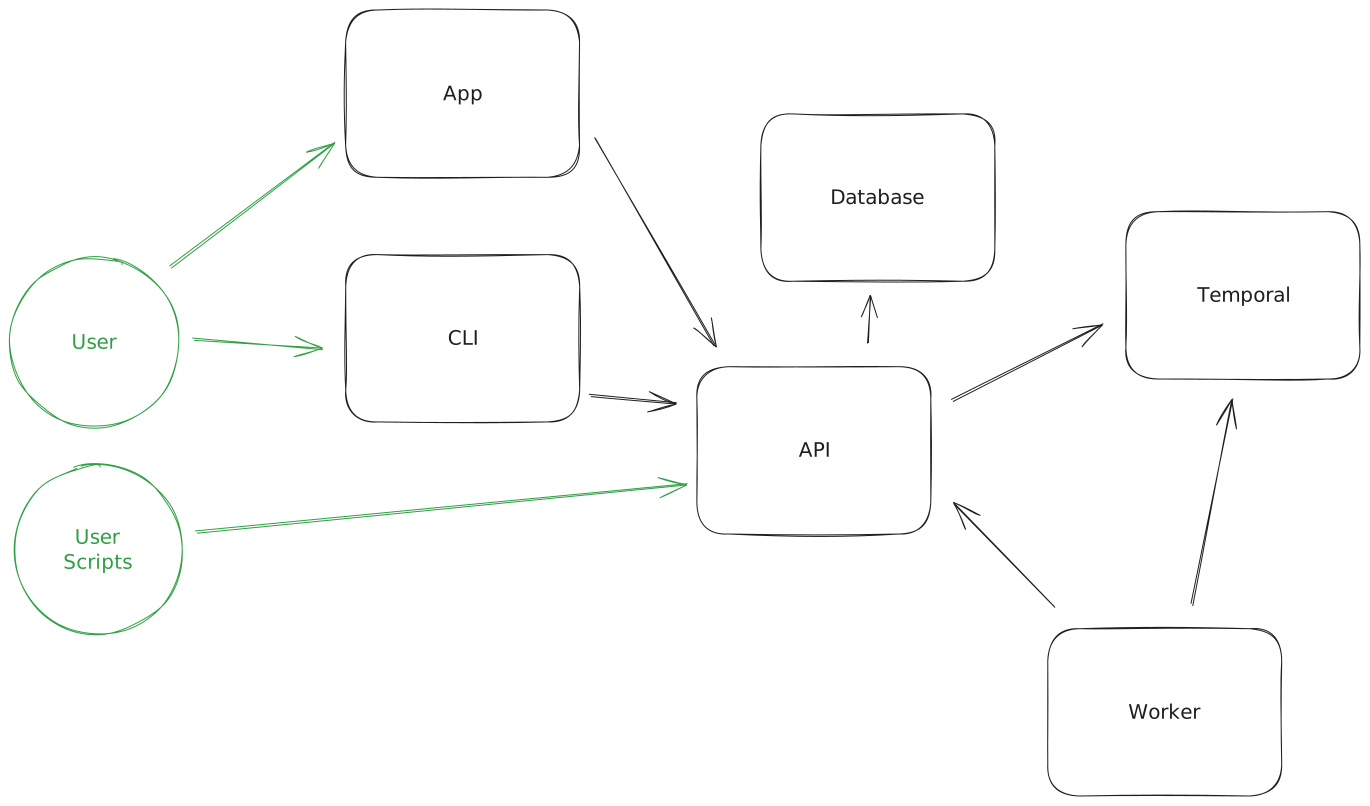
Architecture Diagram
Client-side App
This is the frontend of Husonym. Built using Nextjs. This primarily interfaces with Husonym-Api and acts as a way to easily configure Husonym server settings and workflows.
Client-side CLI
The CLI acts as a way to programmatically invoke operations in Husonym. It's limited in functionality today, but currently gives the ability to do key operations such as triggering a workflow, and synchronizing a connection down to a locally hosted database.
This can be easily utilized within a Github Action to fill data from Husonym Connection to a locally hosted database.
See the CLI section of the docs for a more in-depth guide on the CLI.
Server-side API
This is the primary Husonym API and what most operations are routed through. Written in Golang, it serves up a Connect, gRPC, and Web API generated via Protobuf. It is backed by a Postgres Database, where it stores all of its configurations, except for explicit workflow data, which is deferred to Temporal.
Server-side Worker
The worker process is a Golang based Temporal worker. Think of this in the event-driven world as a queue consumer. When booted up, it listens on a queue specified within a Temporal namespace and will run actions when a workflow is available.
The worker uses mTLS to communicate securely with Temporal, and an API key to communicate with Husonym API. This worker can run anywhere as long as it has appropriate access to do so (Husonym API, Temporal, and Husonym Connections), and can be scaled as needed.
Today the worker is built to handle every job that Husonym has available to it.
Postgres Database
Husonym API uses a Postgres Database to persist all of its data. Everything is stored within Postgres, except Temporal specific data, which is stored specifically within Temporal.
Temporal
Temporal is the primary workflow engine that Husonym uses to invoke all of the Husonym Jobs. There are many benefits to Temporal, and we use it to give us reliability, reproducibility, and metadata around Husonym Jobs.
Redis
Redis serves as an optional external dependency. It's specifically required if primary key transformations are to be utilized. This functionality allows for more advanced data synchronization capabilities by transforming primary keys during the synchronization process, and Redis facilitates this operation by providing the necessary data structure and caching capabilities in order to maintain data integrity.